

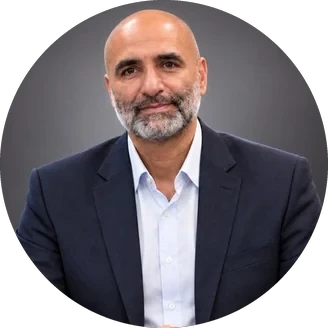
Vahid Nickmanesh
Founder & CEO AI systems builder · Trader · 12+ years running businessesFounder-led product architecture, implementation, integration and execution.
OpsBond combines founder-led systems execution, AI research and evaluation, and commercial product analytics, with the architecture reviewed by external academics in computer engineering.
Vahid Nickmanesh is a founder-operator, AI systems builder and trader. He has an engineering background in electronics and ICT, more than 12 years running customer-facing businesses, and nearly two decades of music and audio practice.
He personally leads OpsBond’s product architecture, implementation, integration and testing. That combination shapes the product philosophy: useful AI should keep context, make state visible, respect boundaries and connect conversations to accountable next steps.
Hands-on architecture, automation and infrastructure: n8n, Docker, Linux, PostgreSQL, Redis, model integrations and realtime voice.
12+ years running hospitality rentals, retail and food service: enquiries, bookings, ownership, follow-up and the cost of unclear next steps.
Owner and managing director of a Dubai free-zone trading company. Develops cross-border produce trade into the UAE and has completed multiple food-product container shipments.
Long-running music and audio practice sets a high bar for cadence, turn-taking and natural interaction.
Nickmanesh, V. (2026). Gulf–Bandari 4/4 Notation System (Version 1.0) [Technical note]. Zenodo.
A teaching framework that maps Gulf–Bandari rhythms, traditionally felt in 6/8 or 12/8, onto a 4/4 sixteenth-note grid, with conducting perspectives, guitar-to-drum mapping, arrangement guidance and DAW/MIDI workflows. Audio and DAW groove references are treated as the timing authority.
In OpsBond, this work informs how voice products are judged: timing, turn-taking, interruptions and naturalness.
Select a person to see their profile.
Founder-led product architecture, implementation, integration and execution.
Evaluation methodology, benchmark design, reliability analysis and technical review.

Operational analytics, KPI modelling, commercial and unit-economics support.
Three computer-engineering academics, outside the OpsBond team, assessed selected architecture materials, technical evidence and controlled demonstrations.
The separation between AI interpretation, operational state, authority, and external action is an important consideration for reliable AI systems.
Assessment: “a serious applied AI project with a research-oriented systems direction.”
The central problem is not AI interpretation but reliably coupling probabilistic interpretation to deterministic operational state, explicit authority, evidence, and controlled external action.
Assessment: “a substantive software and AI systems engineering effort.”
Open questions raised: who validates evidence, how permissions are revoked, how replays are detected under distributed clocks, and how idempotency holds when side effects are irreversible. We treat these as open engineering work.
Maintaining canonical business state outside the language model and orchestration layer is a significant architectural decision.
Assessment: the project “warrants continued technical evaluation, testing, and development.”
Quoted with each reviewer’s permission. The reviewers are external to OpsBond and are academic colleagues of our Head of AI Research & Evaluation. Full signed letters are available to programme reviewers and investors on request.
A quiet personal commitment behind the work.